

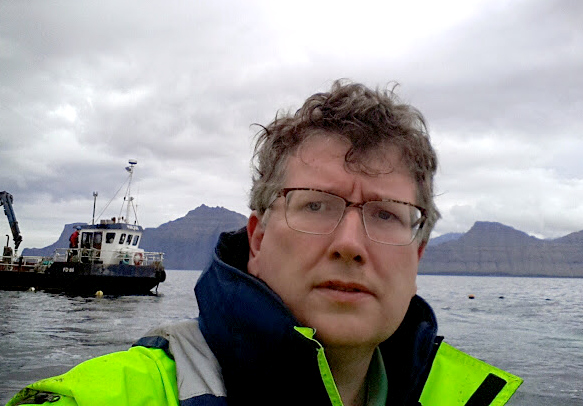
Since the first seed lines were anchored in the open ocean north of the village Funningur in 2010, manager Ólavur Gregersen of Ocean Rainforest has gathered enough data and experience to know that there is a market for the seaweed. Not least that much more research is needed to gather essential knowledge in the field of seaweed cultivation.
– First we wanted to find out if we can grow enough to sustain a commercial seaweed operation. The interest for our seaweed in the market confirms that this is possible, says Gregersen on the phone with Blue Frontier Magazine.
He mainly finds customers for the brown algae saccharina latissima among producers of cosmetics and vegetarian food in Germany.
Gregersen ascribes the market interest to the higher quality of seaweed from open ocean in one of Europe’s more windy outposts.
The reason the seaweed is of better quality than seaweed farmed elsewhere is however still not entirely clear. Gregersen mentions sea depths and sea temperature as the two probable reasons, but the weight of the two elements in the final equation is not yet conclusive.
– The fact is that we can harvest three times a year while other European cultivation projects manage one or maybe two harvests and that our seaweed is of better quality. Here the sea temperature stays between 9-12 degrees Celsius throughout the year. In Norway or Denmark it can reach 20 degrees. Another possible explanation is the depths of the sea where we anchor our seed lines.
No contact, please
He explains that 40-50 meters of water between the seabed and the upper 15 meters, where the seaweed grows, avoids contact between shellfish and other creatures on the bottom and the seaweed. If this or low temperature is the reason cultivated seaweed from other projects are of lesser qualities, he cannot say yet.
– So choosing a deeper anchoring place can compensate for the seawater being warmer than it is at the Faroe Islands?
– That is possible. Our system is designed to be anchored in exposed areas. Here we have waves between 6-7 meters in winter. Our rig has survived for four winters in very high winds. To be in deep water, you need a strong structure.
The rig consists of a main horizontal line with vertical seed lines attached to it.
As a company, Ocean Rainforest follows a commercial and scientific track simultaneously. And Gregersen wants it to continue like that for the years to come. His aim is to do business as well as contributing to building the knowledge base of the field where he operates. That implies sharing know-how with other actors.
– As a company, we have obviously commercial considerations. On the other hand, there are many gaps in the knowledge about this area. My general approach is that you gain more experience by sharing knowledge. We will continue to participate in conferences and engage in networks and explain what we are doing.
Scaling up
Ocean Rainforest is funded privately by Gregersen’s company Syntesa and obtains grants for research from NORA (that supports projects in Faroe Islands, Greenland, Iceland, and Norway).
– We are getting into a phase where we want to scale up the activity. In the last eight months, we have attracted new customers that are very interested in our seaweed. As a result of that we need to increase the capital base of the company. The commercial part of the business is fairly easy to fund with investor money. The research part is, of course, a costly part of the activity that we will try to fund via different grant schemes in the Nordic as well as in the European area.
Intriguing variations
Finding out more about the seasonal variations of bioactive compounds in the seaweed will probably be one of the prioritized research fields shortly.
– In the course of a year the quantities of protein, sugar and minerals varies. There has not been done any research on this aspect of cultivated seaweed. We need to understand more of seasonal variations to be better able to know what substances to extract from the seaweed, depending on the knowledge of when levels are at the highest.
– Does that mean that harvesting as many times as you can during a year might not be a goal in itself if the contents of the seaweed vary?
– Exactly. We need to understand better the relationship between value and quantity in the cultivation activity.
The name of the company indicates how important it is for Gregersen to underline the nature friendliness of the operation he manages.
– Seaweed cultivation does not add anything to the water that is not there already. Additionally, if seaweed grows in combination with fish farming, it will contribute by taking up nitrogen and phosphor. By cultivating seaweed emissions from fish farming can be reduced.
New species
Gregersen (46) is a trained economist with several other business engagements at his CV. His company Syntesa has since 2002 been active in bringing new innovation to the market. Gregersen entered the seaweed cultivation business when the former owner drew out in 2011. He says that his time has been a bigger contribution to the company than capital.
Harvesting other forms of algae with higher protein levels is at the top of his list, not least because poultry and pig farmers might be turned into seaweed customers if the protein levels are high enough.
– Provided the right seaweed species you can produce feed for chicken as well as for pigs.